Hot Springs, Atomic Cities, and Craters of the Moon . . . on the Road in Idaho

Atomic city

‘Our heated sidewalks and dressing room floors keep your toes toasty warm, even on the coldest of nights.’ (www.lavahotsprings.com).

‘Welcome to the sagebrush steppe’ (information board, roadside rest area near Atomic City).

‘We’re praying for rain. There was hardly any snow this year and the reservoirs are low.’ (women in a roadside cafe, Carey)

How to begin is the question. Crossing the Wyoming border into Idaho between Cokeville Meadows National Wildlife Refuge and Montpelier starts an extraordinary exploration of a landscape defined on the one hand by man’s capacity for self-destruction and on the other by a demonstration of the damage that nature can wreak. Nature wins. At least, so far. . .

Nr Lava hot spings idaho

Mountains and pastoral rangelands roll on either side of the Portneuf River valley, with its motel-studded, bijou spa towns of Soda Springs and Lava Hot Springs. Soda Springs has a geyser and naturally carbonated water, while Lava Hot Springs attracts bathers and pipes geothermally heated water into homes. Shoshone and Bannock Native Americans used these springs for centuries, before the ‘hot tubs’ were discovered by fur trappers and mountain men (working for the American Pacific Fur Company and the North West and Hudson’s Bay companies), then by pioneers and settlers. French-Canadian fur trappers named the river some time before 1821. The road follows part of the old Oregon and California trails, and is a goldmine of historical interest. Farmsteads and honeymoon hotels wear a comforting Sunday best of homeliness and hopefulness.

On the other hand, all these places obscure their own past: they were carved out of the sagebrush steppe and high desert that closes in on every side. The land is irrigated and its soil has been artificially enriched, while the Portneuf River, a tributary of the Snake, has been described as a ‘heavily used and anthropogenically altered system,’ in which nitrate discharges from cattle ranching along with other forms of use by the local populations ‘have produced a unique set of chemical characteristics associated with both the biological processes and the interactions with the local geology’ (Wikipedia, ‘The Pontneuf River’). The vast Snake River Basin stretches westward as far as the eye can see from Pocatello (population 54,777 in 2012), the third largest city in Idaho after Boise and Idaho Falls. But as we drive out beyond the smaller western town of Blackfoot into what seems a plain of desolation, other power sources are just over the horizon.
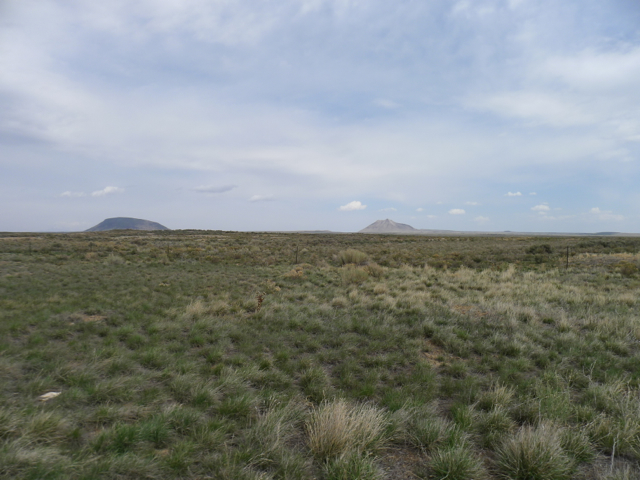
Arco rd buttes

One of the first things you notice while driving through the sixty miles of arid, mile-high plain dominated by sagebrush and bunch-grass between Blackfoot and Arco (US-20W) is that the landscape is increasingly strewn with boulders of varying sizes, long ago hurled through the air by volcanoes. Cinder-black, these rocks are curiously warm to touch even on a cold April day: they bask in the radiation of the sun. Desiccated plants somehow flourish in the parched soil. Straight and flat, US-20W stretches into the distance flanked by the rhyolite lava dome of Big Southern Butte (300,000 years old and rising approx. 2500 ft.) to the left, and the smaller Middle and East Buttes to the right. Unsurprisingly, these massive structures remain important landmarks on this flat stretch of the eastern Snake River Plain. The route retraces the old covered wagon trail of Goodale’s Cutoff, a diversion from the Oregon Trail. In 1862 Tim Goodale led 338 wagons and almost 2000 people through here. Relations between Shoshone and the wagon trains had deteriorated along the regular, more southerly route and he promised a safer passage. A mountain man and long-time trader familiar with Native Americans and their trails, Goodale reopened a passage that had been tried ten years earlier by John Jeffrey and was already known as Jeffrey’s Cutoff. I imagine navigating without roads or maps, in wood-and-canvas wagons, and I’m reminded of Kelly Reichardt’s film of isolation and desperation in the eastern high desert of Oregon, Meek’s Cutoff (2010). Reichardt’s screenplay dramatises mountain man Stephen Meek’s attempt to lead a small group of pioneers by a shorter route than usual to the Willamette Valley. The conventions of regular wagon-train westerns are there: encounters with Indians, running out of water and finding only saline lakes, endless arid plains, sickness miles from anywhere, and a dysfunctional gender gap that tries to put women back in the wagons at the first hint of danger. But those commonplaces are confounded by an extended theme of communication breakdown. In his disastrous attempt to retain authority, Meek can only tell tall tales of fighting bears and Indians to a small boy (the one person he can hold spellbound). A lone Native American whom they find speaks a language that none of the group can understand, and nor can he comprehend them. For lack of interlocutors, he converses with the moon. Wary compassion on the part of one of the women comprises his only meaningful, non-violent opportunity for intercultural human exchange. A grey-green landscape dominates the film, withholding any features that can be translated into cartography by a human imagination. Furthermore, this third film in Reichardt’s Oregon trilogy uses cinematography and sound to convey the problem of trying to converse in the relentless, strong wind of a particular American west. Meek’s Cutoff may be set in Oregon, but it could easily be a story about where I’m standing. Back in our present world of comfortable car travel, Butte County Chamber of Commerce’s website has a History of Arco that provides an informative account of the traffic through and settlement of this part of Idaho.
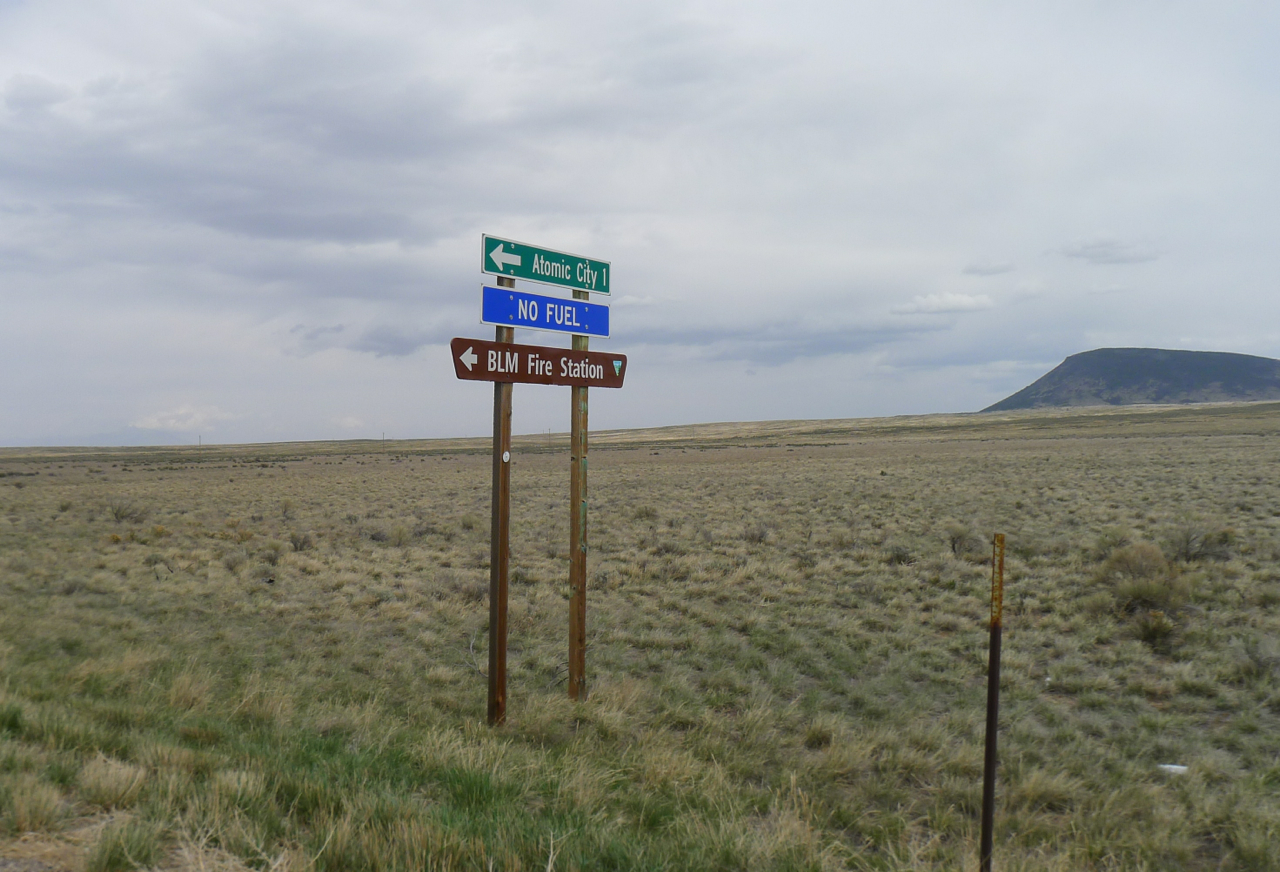
Atomic city sign

After a while, a road sign marks a junction to the extraordinarily named Atomic City. With a population of 29 in the 2010 census (that’s an increase on the 25 entered in 2000), this tiny community a few hundred yards off the main highway has a bar, a store and a stock car racing stadium. But as the sign on US-20W warns, there’s no gas for sale. Deserted buildings lend the town a movie-set atmosphere. Tumbleweed blows along the street. The only sound is the wind. Atomic City changed its name from Midway (indicating its position between Blackfoot and Arco) when Butte County became the site for the National Reactor Testing Station. More than fifty different kinds of nuclear reactor were built in a nine-hundred-square-mile area, to develop atomic energy and a nuclear naval capacity. Atomic City never matched the size of Arco, a few miles along the road and the first town in the world to be lit by atomic power. But its dogged persistence in surviving matches that of the plants and animals of the prairie.

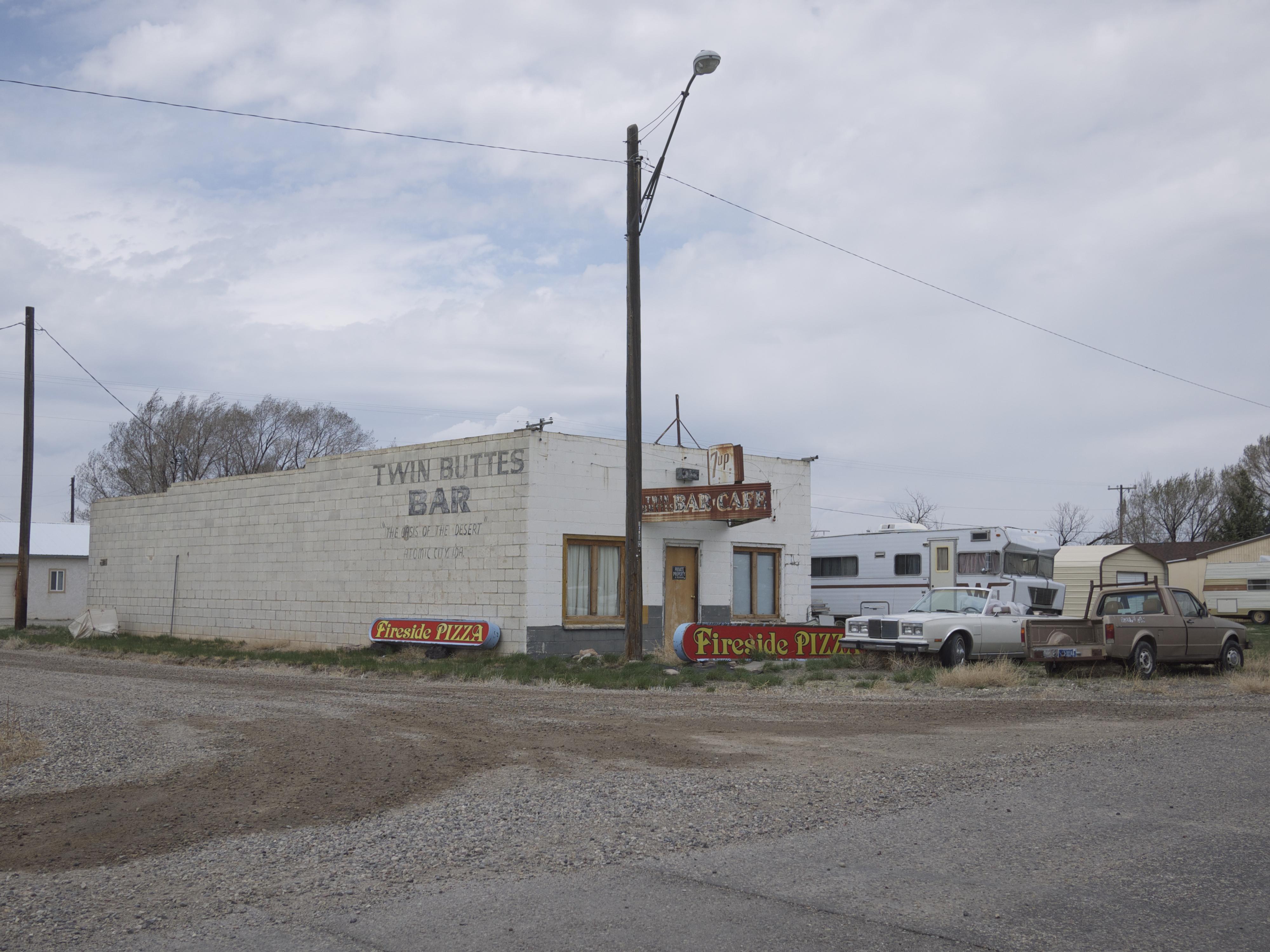
Atomic City 2

Atomo

Back on the highway, larger signs announce the Idaho National Laboratories industrial and research complexes, the Department of Energy STAR Voluntary Protection Program (‘Visitors: all injuries are viewed as preventable’) and the Atomic Museum. I wanted to visit the museum, which is housed in the decommissioned reactor EBR1 that lit Arco. Unfortunately, it is closed at this time of the year. It’s now also a National Historic Landmark. Visitors have compared it with the Smithsonian Air and Space Museum for interest. Instead, we settled for a picnic at a rest area overlooking the dry bed of the Lost River . . . a water source which has disappeared, as its name implies.
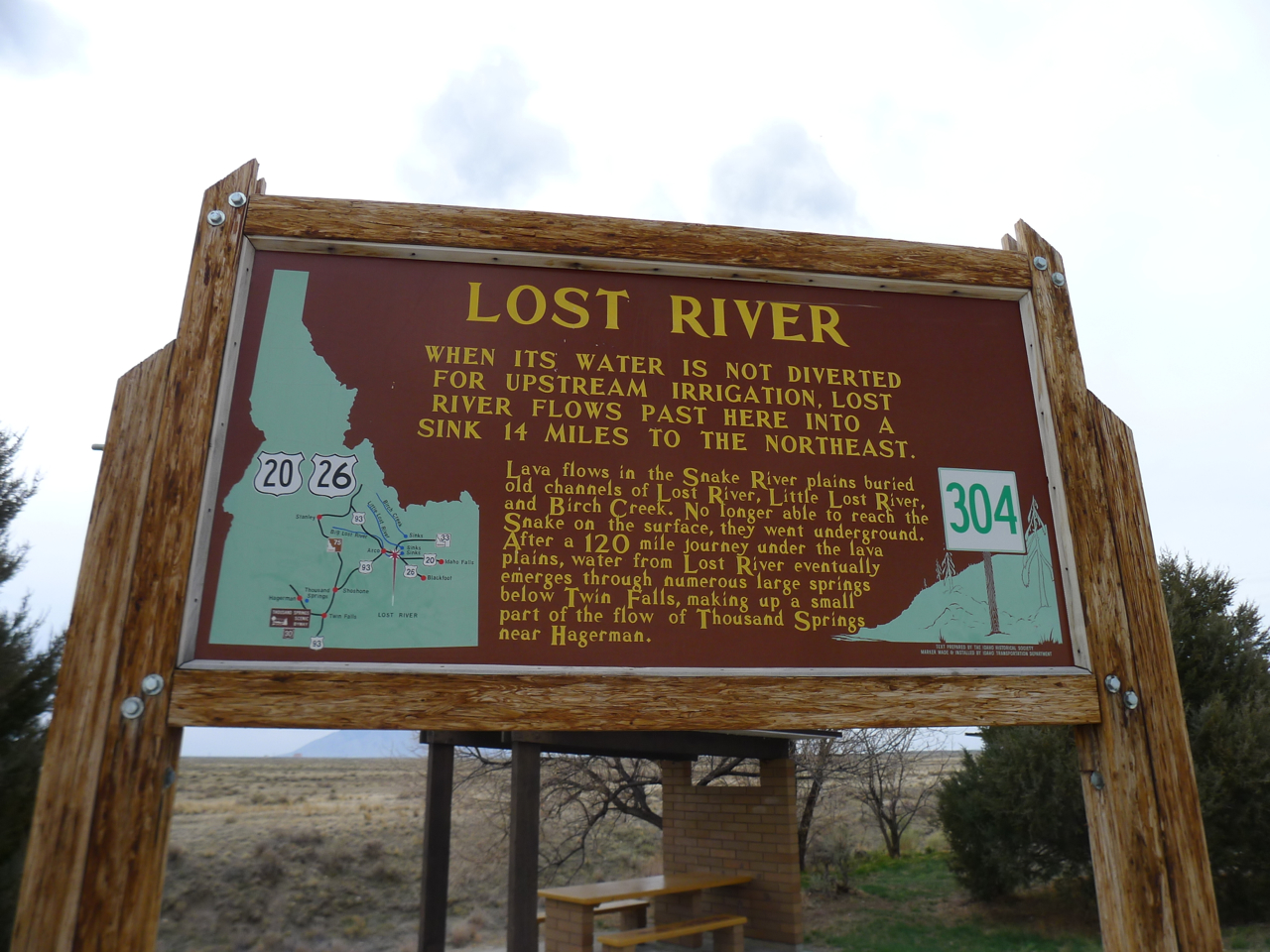
Arco lost river

Arco lost river bed

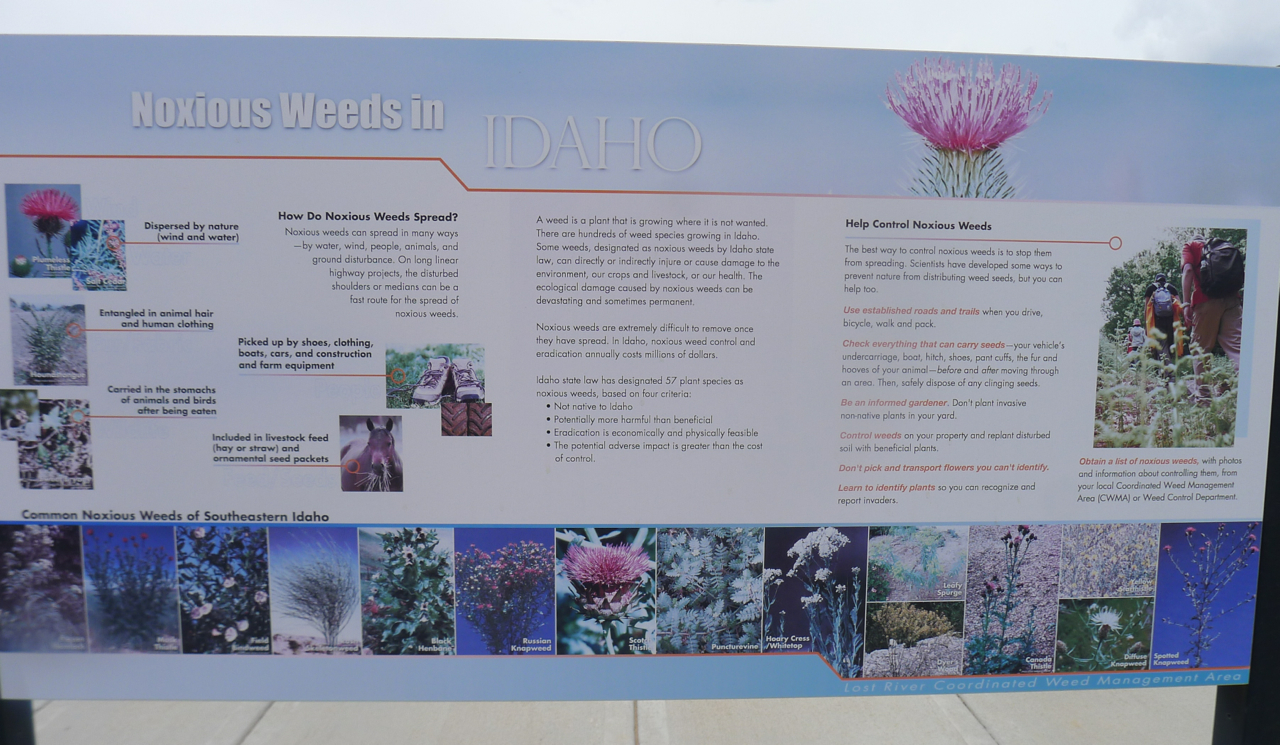
Atomic city weeds notice

Information boards around the rest area display a basic narrative of the potential for massive destruction as well as cheap power that is all around, while warning about the damage that can be done by introducing non-native plants and animals to what is a fragile and beautiful ecosystem. I like the final emphasis on the delicacy and value of life, and try to convince myself that it implies enough concern for the environment that we share to indicate a sense of hope. Arco, a few miles further along the road, with a population of 995 in 2010, still greets visitors with an advertisement for Pickle’s Place, ‘Home of the Atomic Burger.’ Well, we’d had lunch. . .
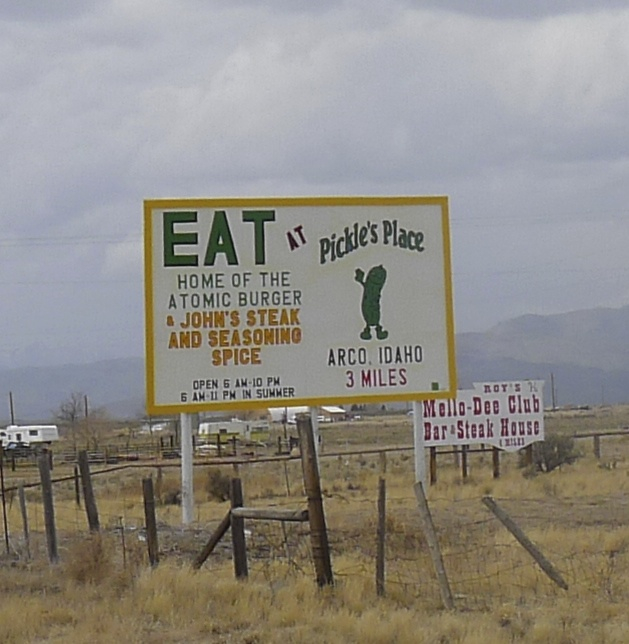
Arco atomic burger

My mind skips to cinema again, but this time to Richard Lester’s Superman II (1980) in which arch-villain Lex Luther’s Kryptonian sidekicks turn up in the fictional small Idaho town of East Houston to wreak havoc with their heat-ray vision. A boy who leaps onto a horse to ride for help is killed by one of the intruders, without having the opportunity to ‘grow into a man.’ Aliens? Maybe that’s going too far . . . or could the controversial scene in a feel-good family movie and TV series allude to a more real and present danger? In 1961 the U.S.’s only known deaths directly attributable to a reactor accident took place in this area near Arco. A steam explosion at NRTS Reactor SL-1 initiated a partial core meltdown, and three operatives died. Books have been written about the incident, films have been made, official papers published, and there’s a video on YouTube.

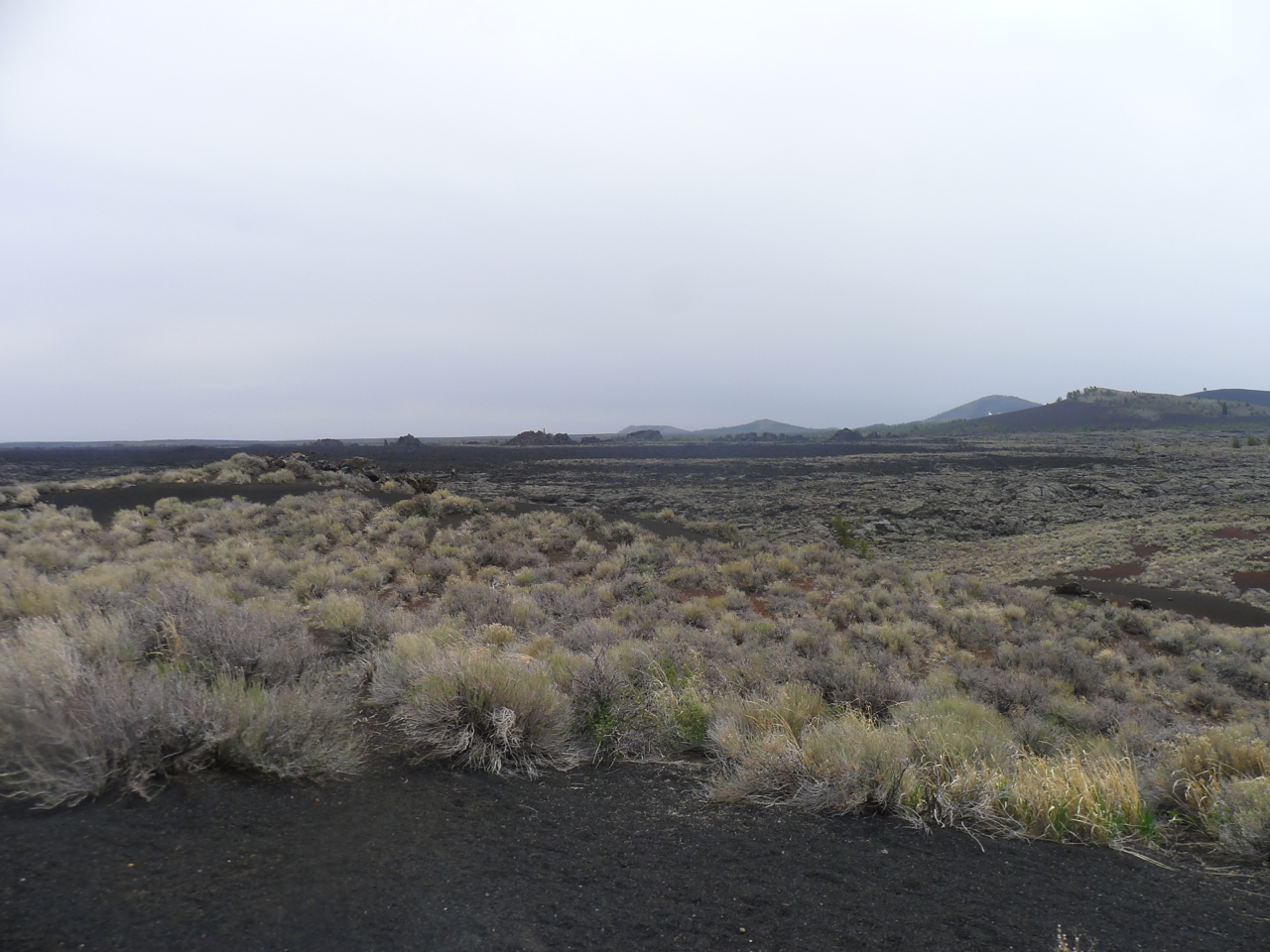
Enough of atomic power and superheroes. Most people who travel this route also visit the 1,100 square-mile Craters of the Moon National Monument and Preserve. Craters of the Moon is a spectacular demonstration of the violence that nature itself can wreak and another affirmation of the triumph of life. The entire area is a black-soiled, burned lava field resulting from a volcanic eruption 2000 years ago. In 1901 Israel Russell, of the U.S. Geological Survey, described the main formations as ‘cinder buttes,’ capturing their charred appearance. I’m interested in periodical journalism. Robert W. Limbert’s 1924 article for National Geographic that led to the creation of this National Monument is worth reading, courtesy of the Park Service website. The wind here was even stronger than on the atomic plain. There was no possibility of walking any meaningful distance. Again, the site is replete with a history that is more than geological and that puts in question the use of the term ‘wilderness’ on an information board (it’s a wild place, granted). Jean Baptiste Charbonneau, a member of Lewis and Clark’s expedition and later a trapper working for the American Fur Company, nearly died near here in 1831. Tim Goodale and his wagon train passed nearby. Shoshone are among the people who have moved through the area across centuries. The deeper ecology is particularly interesting, for plant, animal and bird life is diverse and flourishing. Antelope bitterbrush (Purshia tridentata) grows on the bare black earth while limber pine (Pinus flexilis) and juniper are the dominant trees. Islands of localized vegetation, called Kipukas, are home to some rare species. I saw a yellow-bellied marmot – a sub-species unique to Craters of the Moon – and a ground squirrel, possibly also of the kind found only locally. Spatter cones, lava tubes and cinder buttes give the place its name. One is called ‘Inferno Cone,’ perhaps alluding to Dante’s poem. The information sheets claim that Big Cinder Butte, at 700 feet above the plain, is one of the largest purely basaltic cinder cones in the world. We peer into spatter cones, while listening to the wind.
Craters of the moon 1

Craters of the moon 2

Craters 4

I am minded to consider whether we are arrogant to presume that we have the ultimate power to destroy or save this planet on which we live our precarious existence. Here, in an environment that evokes the burring marle from Milton’s Paradise Lost, life goes on . . . although it’s no place for humans.

The drive on to Boise takes us along river valleys and more plains, with pasturage on either side of the highway. Two women in a roadside coffee house in Carey say they are praying for rain, that there was little snow for the third winter running, and that the reservoirs are seriously low. Their calling for rain in what is a desert of the American West participates in a rite that stretches across cultures to origins in much earlier Native American societies. This is Hemingway country, too. I’m told that E.H. fished these streams lined with tall cottonwoods and vivid, sprouting willows. He eventually shot himself at his home built of cinder blocks designed to look like wood, in nearby Ketchum.

We see sandhill cranes in tilled fields, and wind up and then down through mountain passes until Boise comes into view, around a corner and just a couple of miles in front of us. It is like an oasis. A city of trees, as its name (from the French boisé) implies. Basque shepherds have settled here, relatively recently. The rain finally falls steadily, from a lead-gray sky. I’ll write about Boise hospitality, the Guernica Tree, red-tailed hawks, ospreys, and cutthroat trout in my next post.

Posted in American West, Ecology, Environment and walking | Tagged , , , , , , , , , , , , , , , | 1 Comment

Getting to the Roots of the Matter: Trees and the Environmental Imagination in 19th Century Literature.

11216836a6f9eeff8e983b15a13a1fc5.gifA video recording of my lecture in Interdisciplinary Explorations: The Idea of Nature Public Lecture Series at Boise State University, Idaho is now available at Boise Scholarworks. Thanks to the sponsors for their generosity in making the series possible, to my colleagues at Boise State University and the College of Idaho for the warmth of their welcome last week, and to everyone who came to hear my talk.

Posted in Ecology, Environment and walking, Fiction, Poetry and Essays, Trees | Tagged , , , , , , , , | 4 Comments

Sage Grouse Lekking and Canyon Fiction.

Green river 3
Green River at Green River City, where John Wesley Powell’s Grand Canyon expedition was launched.

The grey-green sagebrush steppe and yellow and red rock canyons are two of the most contrastive, distinctive, colorful environments of the North American West. Arid and ancient, each supports its own vulnerable ecosystems. Over the last week or so, I’ve tried to further my understanding of these places in which it would be all too easy to become lost; firstly through a field trip onto the steppe and secondly through reading John Vernon’s excellent novel about John Wesley Powell’s first journey down the Green and Colorado rivers to the Grand Canyon, The Last Canyon (Mariner, 2001).

There’s something thrilling about going out onto the Wyoming sagebrush prairie before dawn to see a greater sage grouse lek. I left Laramie on such a journey in freezing temperatures, at 4:40 one morning about a week ago with a small group of friends from the Berry Biodiversity Institute and other University of Wyoming departments. As we drove northwards, Venus shone low, larger and more brightly than I’ve ever seen on the eastern horizon. The skies outside of towns in Wyoming are dark, because there is relatively little light pollution in this sparsely populated, high elevation state. Laramie is 7,165 feet above sea level. The highest point in the state is Gannett Peak, in the Wind River Range, at 13,809 and the lowest is 3,099 along the Belle Fourche River, Cheyenne. We neared our destination as the first hints of daylight were turning blackness into a deep blue, with a long, silver gash marking the distant point where the hills met the sky. The grouse were already visible, the males performing their elaborate ritual of strutting around with puffed-out chests and fanned, spiky, starred tails. Like Kings of the Night. Their constant inflating and deflating of the two yellow, balloon-like skin pouches on their white-feathered chests produces a strange, low quobble sound. I am unsure whether the lek provides protection on the basis that there is more safety in numbers, or whether it draws predators’ attention. The birds certainly became increasingly visible as the daylight came. We counted 35 males, each trying to attract a mate although almost every one of them will fail (a dominant male in the middle of the group mates with more than 80% of the females).

Sage grouse are iconic birds of the high sagebrush environment, and might be regarded as a high-profile species because of the attraction of their display. As I watched their extravagant behaviour, I wondered about the many, less noticeable species that fail to renew themselves and are lost without – or almost without – notice. The grouse are a valuable indicator of changes in biodiversity, with numbers declining because of a continuing reduction in suitable habitat. Wyoming has the world’s largest greater sage grouse population, with around 54% of the total number. The winter 2014 issue of Western Confluence (a new magazine published by the Ruckelshaus Institute in the Haub School of Environment and Natural Resources, UWYO) includes a compelling article in which Michael J. Brennan discusses the birds’ decline along with the various measures and incentives that have been introduced to protect them. The Federal U.S. Fish and Wildlife Service will decide in September 2015 whether to list the greater sage grouse as an endangered species. Michael Brennan assesses the evidence as it stands, exploring the case for and against listing. The Bureau of Land Management provides a map with commentary on breeding density that draws attention to the Wyoming grouse population. In Colorado, the slightly smaller Gunnison sage grouse are also the subject of protection strategies. I feel humbled and privileged to have seen this group of birds.

Dawn on the Prairie

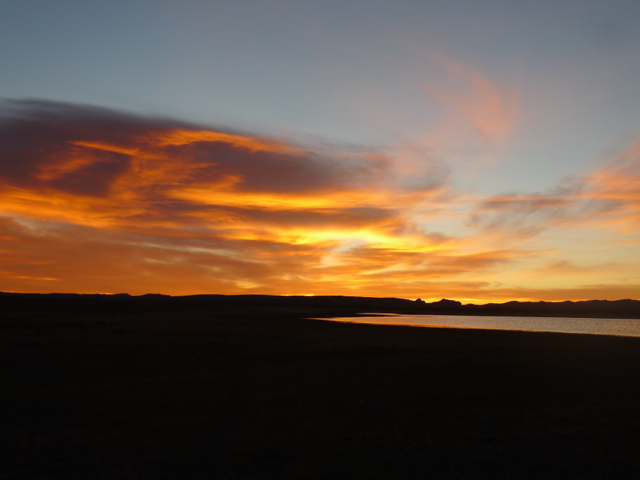
A brilliant, fiery dawn added to the spectacle, and we saw pintail ducks, countless meadowlarks as well as plenty of pronghorn before returning for the most sociable of breakfasts at the Laramie Chuckwagon. I’m indebted to my UWYO hosts for this experience. Carlos Martinez del Rio (Director of the Berry Institute) is an expert guide, and his telescope was a welcome supplement to my Nikkon Monarch binoculars (8 x 40s, good in low light, and I’m glad that I bought them). Eric Sandeen, a good friend, Professor of American Studies at UW, and Founding Director of the Wyoming Institute for Humanities Research came with us. I was not able to take pictures of the grouse as I would have needed a specialist camera, but Western Confluence contains some stunning photos. Other reading that I particularly recommend in this number includes a fascinating account of the effects of different grazing policies on plant species diversity in ‘Cattle as Ecosystem Engineers’ (Justin Derner, David Augustine, and Emily Kachergis) and Emilene Ostlind’s ‘The Ecology Of Fear,’ which considers how to map the effect of Yellowstone wolves in a behaviorally mediated tropic cascade down the food chain (from elk to beavers, and other small animals, through insects to microbes and plants). I’d heard the story — Ostlind presents evidence to suggest that it is just a story verging on myth – of wolves reducing elk damage to aspens, bringing back beavers and their ponds, etc. Romantic, wishful thinking? Jessica Clement’s ‘Humans: The Wildest Animal in the forest’ is a short, thoughtful essay on social science and forestry in the Tetons, while in ‘Notes from the Field’ Anne Jakle looks at Carbon County’s Chokecherry / Sierra Madre project and wind farms. Indy Burke, editor of the magazine, provides an ecologist’s retrospective on the 2012 wildfires (‘Regen’) and Chad Baldwin addresses concerns over ground-level ozone problems and smog in ‘Collaborative problem solving in the gas fields.’ Alex Latchininsky and Scott Schell are co-authors of a short, informative article on the songs of Wyoming’s cicadas. Rancher, Haub School Advisory Board Member and former Director of the FWS, John Turner rounds off with an essay on the value of environmental stewardship as good business and good practice.

Unknown-5

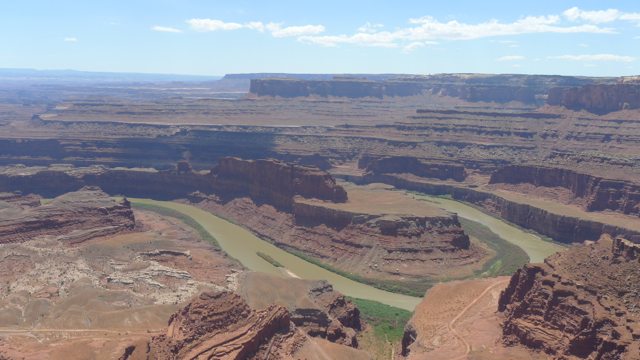
So on to literature and the romance of adventure. The Last Canyon was the final book that I discussed with my UW graduate student group. John Vernon fictionally treats the 1869 first voyage of John Wesley Powell and his entourage of explorers by boat from Green River City in Wyoming, through Utah and Arizona to the Grand Canyon. Yet he does far more. The narrative of Powell’s journey is carried by his evocation of western explorer grit and white-water, river-running vigor, mounting human tensions, a diminishing supply of food, fear of encounters with Native Americans and a mood of almost unbearable nervous suspense to match the sublimity of the terrain. Even though he eventually finds his canyon, Powell is confounded in his attempts at the impossible: to give one instance, he tries to give names to all the landscape features as he and his men descend deeper and deeper into the eroded landscape (he already had more than a hunch that John Muir’s glaciation hypothesis was correct: see my last blog post for more on Muir). Faced with the seemingly endless devastation of buttes, stacks and mesas that comprise what we now know as Canyonlands, near Moab, his taxonomic capacity fails. Measuring the journey in terms of decreasing elevation rather than linear miles, the narrative resembles a journey into the underworld. In keeping with that ancient and appropriate literary trope, Powell’s was a journey of self-discovery and disturbing encounter, as well as an exploration of the wild American landscape.

Canyon lands

There is a neat structural twist. The chapters relating to Powell’s voyage are interleaved with a parallel story about a small group of Shivwits Paiute Americans who live around the rim of the Grand Canyon. Their story is given equal coverage. Common experiences emerge, connecting the two groups in devastating ways. Powell lost an arm after being shot in the Civil War at Shiloh, and he recalls in detail the amputation; meanwhile, one of the Shivwits women has been shot in the arm by gold miners. Her wound festers, as her companions use the only medicine that they know. Toab, leader of the Shivwits shares a common character trait with Powell, described aptly by Verlyn Klinkenborg in his review of the novel for the New York Times as ‘disbelief in the same things’ (November 11, 2001). Perhaps Toab’s most tragic disbelief is that people could not (or at least, would not) come down the river. Both parties are searching for something: Powell for the ultimate discovery of the Canyon, but also for a more spiritual experience that eludes him, and Toab’s Shivwits for some lost children. Just as the landscape is a worn away creation of material absence, so loss is an overwhelming motif of the entire story. To say much more would involve spoilers. Let’s just say that a story involving these rivers and canyons is bound to be concerned with confluences. This is a fabulous novel. John Vernon’s conclusion is devastating. The students and I loved it, and it generated some of the best conversations of our time together.

I’ll conclude by concurring with the New York Times review: The Last Canyon is just ‘too good a piece of fiction to be called a novelization of that summer when a short, one-armed Union veteran of Shiloh — tainted more than guided by his father’s orthodox Methodism — plummeted into that great seam of rock and river.’

I have not yet seen the Grand Canyon. On my way to Boise, Idaho, at the end of last week I visited Green River City and stood on the spot where John Wesley Powell launched his expedition. That was a special moment. I’ve also stood on the rocks by Lake Powell and Hite City.

Posted in American West, Birds and Animals, Environment and walking, Fiction | Tagged , , , , , , , , , , , , , | Leave a comment

Of Rocks and Hard Places . . .

Vedauwoo 1
I was talking with my group of graduate students about John Muir’s essays originally written for newspapers, published in the collection Travels in Alaska (1915). Muir developed a hypothesis during the 1870s revising accounts of how the geological landscape of the Western U.S.A. was formed: he was sure that the canyons and valleys were the result of glaciation, and not of a massive earthquake (the accepted theory at the time). The first of his five trips to Alaska (1879) enabled him to test that hypothesis by observing and measuring existing glaciers and examining their moraine. Muir (b. 1838) was a first generation Scottish immigrant who had ‘gone west’ to California after moving with his family to Wisconsin from Dunbar, near Edinburgh, aged eleven. He became intrigued by the geological – and bioregional – connectedness of the most northern U.S. State and the worn-away landscapes of the more familiar South West, writing about the continuum of erosion that could still be seen taking place. While noting that the flora and fauna at such different latitudes had few species in common, Muir compared the mineral and ecological structures of Alaskan river and glacial canyons to those in Yosemite. One such comparison of the Stickeen river valley shows his characteristic interweaving of scientific analysis and aesthetics:

The majestic cliffs and mountains forming the cañon walls display endless variety of form and sculpture, and are wonderfully adorned and enlivened with glaciers and waterfalls, while throughout almost its whole extent the floor is a flowery landscape garden, like Yosemite (Ch. IV, ‘The Stickeen River’).

After persuading the captain of the steamship on which he was travelling to make a digression during a return journey to Wrangell, Muir takes that comparison a stage further into a narrative suggestive of geological time travel:

On either hand rise a series of majestic, pale-gray granite rocks from three to four thousand feet high, some of them thinly forested and striped with bushes and flowery grass on narrow shelves, especially about half way up, others severely sheer and bare and built together into walls like those of Yosemite, extending far beyond the ice barrier, one immense brow appearing beyond another with their bases buried in the glacier. This is a Yosemite Valley in process of formation, the modeling and sculpture of the walls nearly completed and well planted, but no groves as yet or gardens or meadows on the raw and unfinished bottom. It is as if the explorer, in entering the Merced Yosemite, should find the walls nearly in their present condition, trees and flowers in the warm nooks and along the sunny portions of the moraine-covered brows, but the bottom of the valley still covered with water and beds of gravel and mud, and the grand glacier that formed it slowly receding but still filling the upper half of the valley. (Ch. V, ‘A Cruise in the Cassiar’).

Nowadays spelled ‘Stikine,’ that river and its canyons are still described as a ‘wilderness area.’ Wilderness being a marketable commodity, the designation is undermined by the availability of tourism, including jet boat hire and bear observatories, and the fact that the area had long been home to native Canadians. The name Stikine is a transcription of the Tlingit for ‘great river.’

Travels in Alaska represents episodes from the voyages that Muir made in 1879, 1880 and 1890. Motifs of ice, rock, rivers, salmon, trees, plants and skies shape the essays, along with anthropological accounts of the lives of First Nations Canadians. A sense of wonder at the magnitude of the Alaskan landscape informs the collection, from the ‘vast expanse of open rolling prairie like highlands’ (Ch. 6, ‘The Cassiar Trail’) and ‘the glittering bergs, the crystal bluffs of the vast glacier, and the intensely white, far-spreading fields of ice’ (Ch. 10, ‘The Discovery of Glacier Bay’), to the ‘ice-cliffs, pinnacles, spires and ridges’ that suggest ‘a magnificent picture of nature’s power and industry’ (Ch. XVII, ‘In Camp at Glacier Bay,’ 1890 trip). At the same time, moments of quiet familiarity include the botanical cataloguing of species also found southwards throughout the river valleys and mountains of British Columbia and the western states of the U.S.: cottonwoods, willows and aspens.

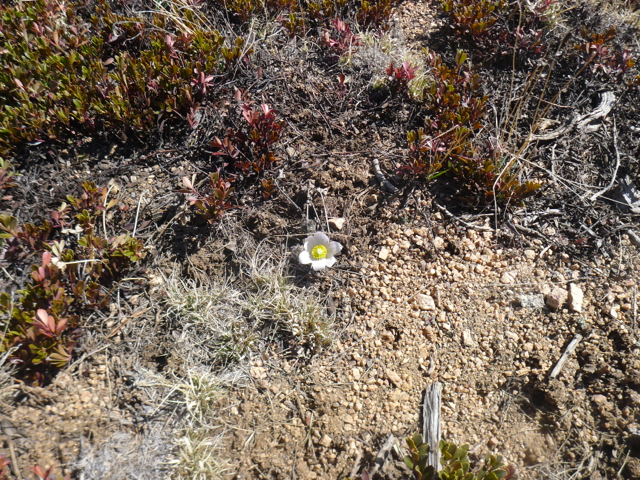
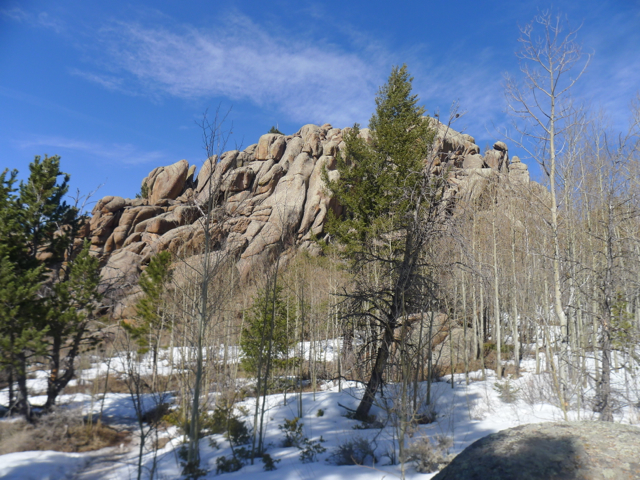
I’d spent the day before our discussion hiking at Vedauwoo, in the Medicine Bow-Routt National Forest near to Laramie. The trails in this area of dramatic, Precambrian Sherman Granite formations are popular with walkers, as are the rocks with climbers, but if you go midweek in April you will feel that you have the place more or less to yourself. I’ve been here three times and seen almost no-one. The road through from Happy Jack was closed and snow still blocked the car park, but the thaw and clear sunshine gave a sense of spring that was confirmed by the aspen buds, willow catkins, and a solitary pasque flower.

Vedauwoo is scared to the Arapahoe, who call it ‘earth-born,’ and, by extension, ‘place of the earth-born spirits.’ The hoodoos and other rock formations are spectacular, providing stunning scenery at an elevation of around 8,200 to 8,400 feet. As the University of Wyoming points out, the rocks are among the oldest in the state at 1.4 billion years but are still only half the age of the Teton mountains. It isn’t difficult to see why Wyoming is such a paradise for geologists.

Vedauwoo rocks 3

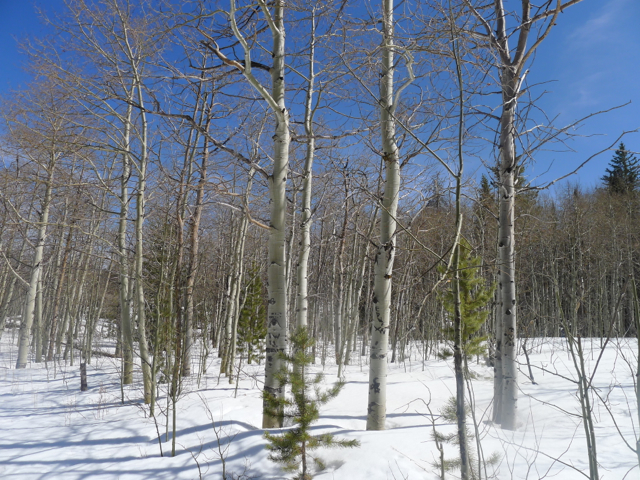
We took the Turtle Rock trail in reverse, beginning with a grove of aspens close to some beaver ponds.

Aspens at Vedauwoo

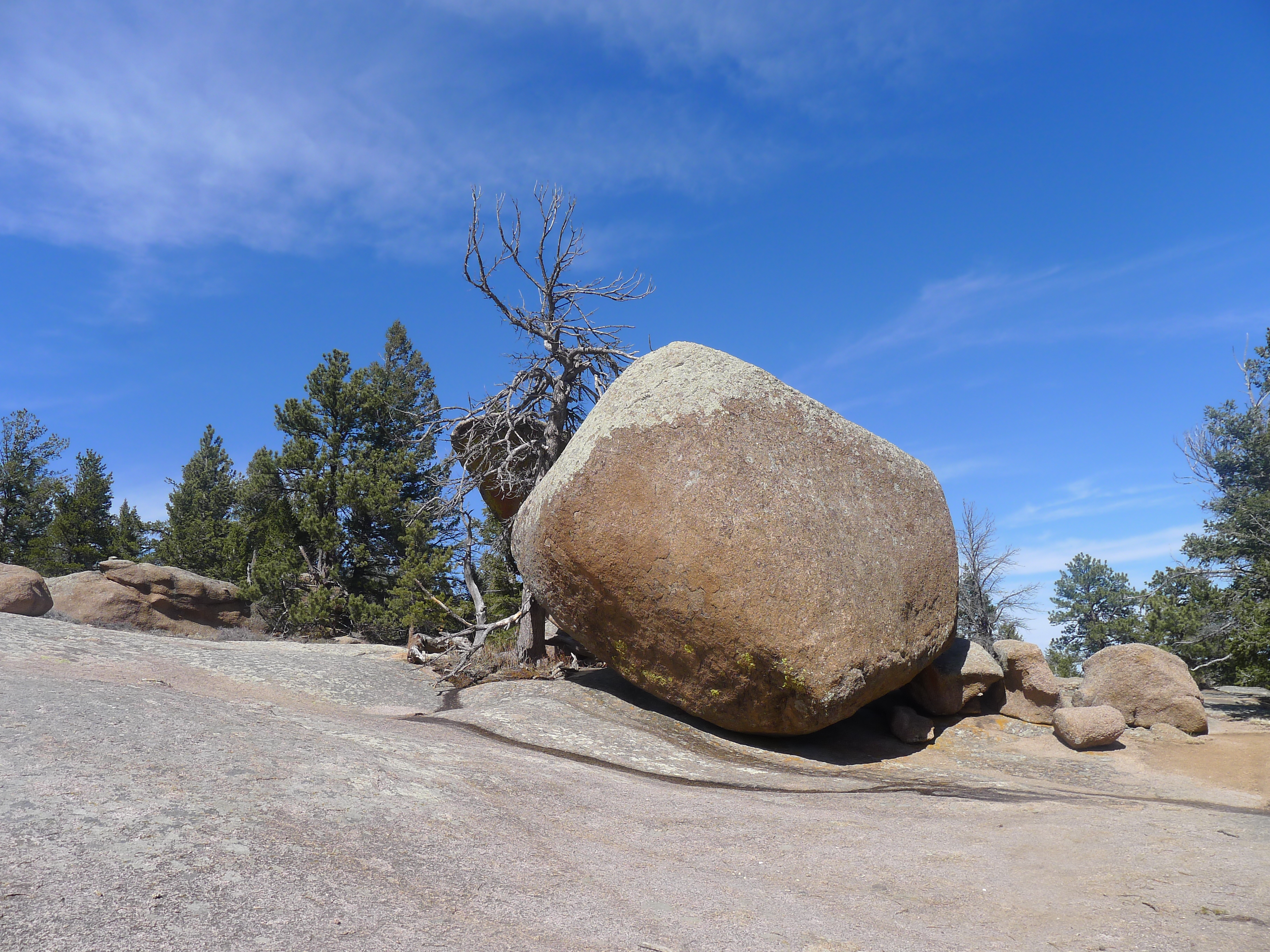
There were no signs of beaver activity, but birds included Mountain Chickadees and, I believe, a golden eagle soaring around Turtle Rock. A ground squirrel ran into a hole under some rocks. The route winds around the main outcrop of Turtle Rock to an area where pink boulders, some of them almost the size of small houses, balance on top of huge, smooth flat slabs.

P1100040

Lichens thrive on these rock surfaces. It pays to watch your footwork, as you can easily slip. That part of the trail leads through a marshy track of land with streams into an undulating forest path through mainly Ponderosa Pines (with some Limber pine, Spruce, and Douglas fir) and more large boulders. The effects of pine beetle can be seen.

View with dead tree, Vedauwoo

Snow melt has exposed areas of grass that are showing signs of green and it was here that I found the solitary pasque flower. Other vegetation is mainly sagebrush.

Pasque flower at Vedauwoo

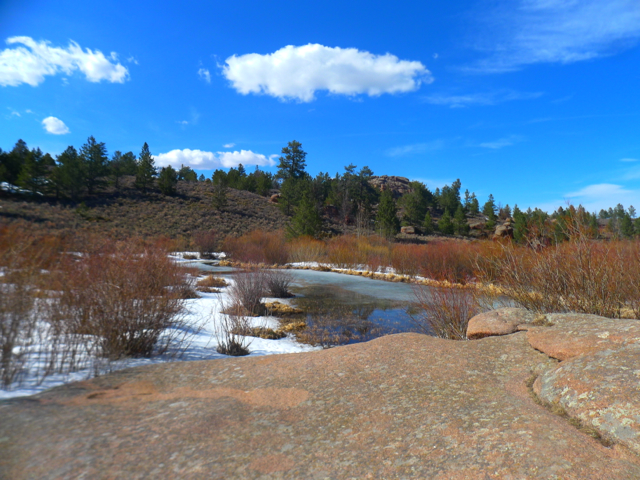
The view of the boulder and main outcrops are spectacular all along the trail, but in this section there are extensive views across the glacially eroded valley toward the Sherman Mountains and Happy Jack (another area with plenty of hiking trails). Descending, the forest path opens out onto an area of interlinking ponds with willow and more aspens. A sound of running water broke the silence, with the ice melting under the azure sky into dark, ultramarine pools of water rippled by the still-frigid wind. Moose often feed here, but all we saw was deer scat and a variety of footprints.

Ponds at Vedauwoo Ponds 3 at Vedauwoo

We continued through another aspen grove to an extensive area of rough boulders and granite outcrops back to the sheer walls of Turtle Rock, turning upward through fields of hoodoos to end the hike.

Vedauwoo rocks

Rather than return home immediately, we took a dirt road to explore an area of high plains shortgrass prairie. Along this open, almost treeless track (with only stunted pines and some cottonwoods, willows and aspens in the few, sheltered ravines) were raptors – at least two different kinds of hawk – but I was unable to identify them. A roan Texas longhorn steer looked at us from behind a fence. The wind was more relentless here than at Vedauwoo, and it felt as if we were at the top of the world. On the other side of the pastel green, tawny and red stretch of the prairie and valley, the Snowy Mountains shimmered under the sun.

High Plains shortgrass prairie

* Travels in Alaska was edited and published the year after Muir’s death, by his friend and biographer William Badè. I’ve referred here to the original edition published by Houghton Mifflin and made available online by the Sierra Club at http://www.sierraclub.org/john_muir_exhibit/writings/travels_in_alaska/

Posted in Environment and walking, Poetry and Essays, Trees | Tagged , , , , , , , | Leave a comment

Overhauling. . .

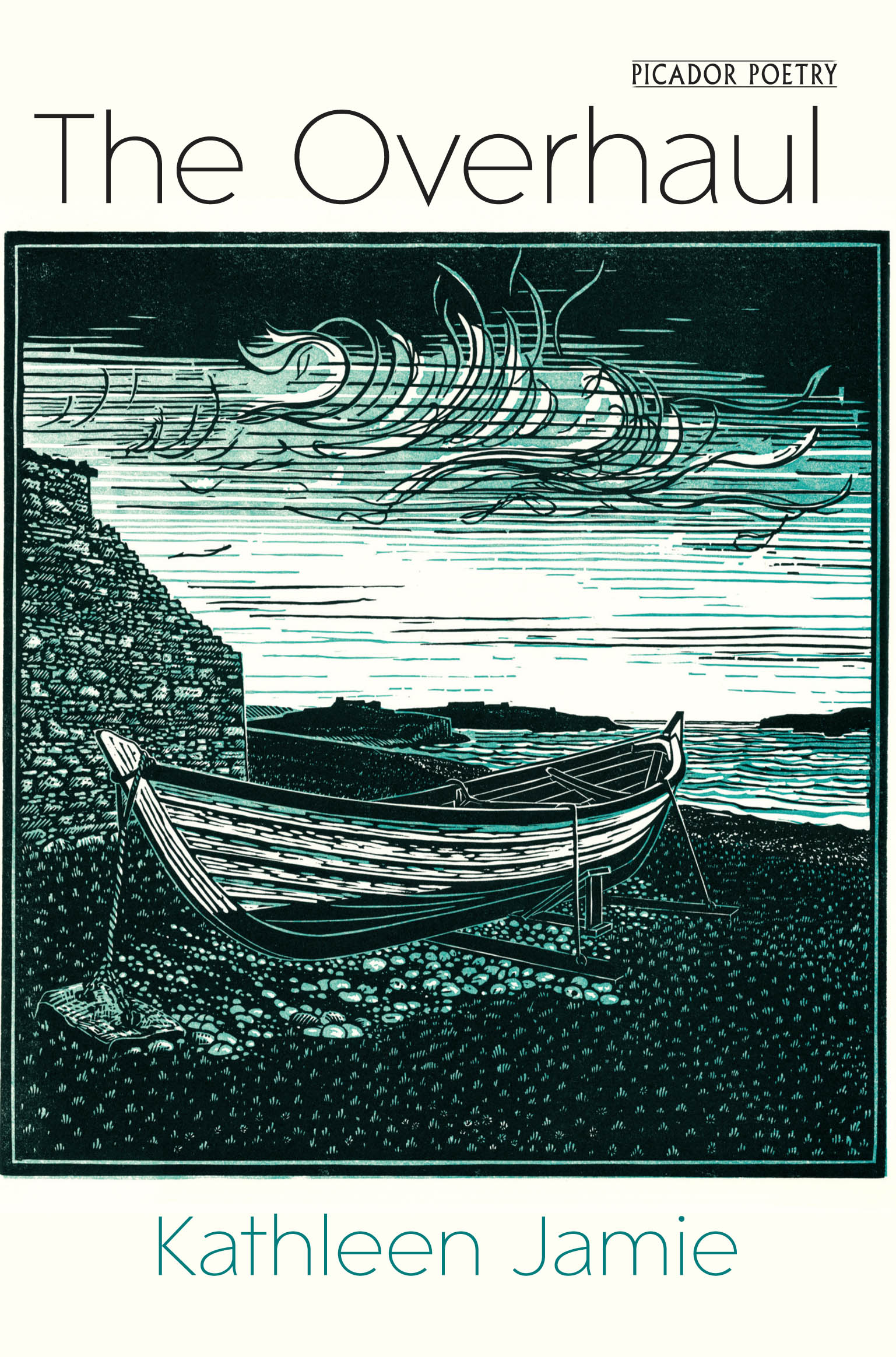
the-overhaul-978144720204201  I’ve been reading Kathleen Jamie’s collections Sightlines (2012) and The Overhaul (2012), in readiness for a graduate student discussion. The Overhaul is a collection of lyrical poems that, amongst other things, confronts the paradoxes and pains of isolation and our desire for shared experience. Each poem reaches for connections – literary, linguistic and cultural. Maria Johnnston wrote in her review for the Guardian that these ‘dynamic and disturbing’ poems owe a debt to Seamus Heaney and Gerard Manly Hopkins. I’m a Romantic studies specialist with an interest in literary places and memory, so other voices also spoke to me from among the witch-note voices of the past.  Jamie’s response to Friedrich Hölderlin, acknowledged in the poems ‘Tae the Fates’ (38) and ‘Hauf o’ Life’ (48), connects wittily with German Romanticism. Her quiet use of Scots-frisian words (‘swier,’ in ‘Tae the Fates’) adds an elemental sense of northern connectedness: etymology connects ‘swier’ with German ‘schwer,’ Dutch ‘zwaar,’ Swedish ‘svår’ and the Middle English ‘sweer.’ The lineages extend into deep time, in the sense that Wai Chee Dimock defines that critical term in Through Other Continents, to roots in Latin and ancient Greek. ‘Tae the Fates,’ – like many of Jamie’s other poems – looks back to the origins of the western literary tradition. The mixture of Scots (my students say it sounds exotic) and English performs a danse macabre of frustrated desire – ‘but gin ah could mak whit’s halie / an maist dear tae me – ane perfect poem.’ The lineages don’t stop there, and there’s more enquiry through dictionaries to be done. After the fragments and glamourie (the title of the poem on pp. 42 – 43, and a word I’ve written about elsewhere), the motifs of sky, water, birds, trees and islands, the last poem in the collection responds to W. B. Yeats’s ‘The Circus Animals’ Desertion’ – Jamie writes that we’re ‘out all day and damn all to show for it,’ with ‘bird-bones,’ ‘rope-scraps,’ and ‘a bit o’ bruck’s’ being ‘all we’ll leave behind us when we’re gone’ (50). I’ll write more about this collection, which I love. Jamie is a Saphho of northernness. (And the James Dodds’s linocut on the cover is a lyrical piece in its own right. . .)

Sightlines shares motifs and themes with The Overhaul: the sea, the sky, the wind, birds, whales, bones, stones, islands, light, dark, sound, silence, isolation and desolation. The genre being the essay, narrative here competes with a lyricism that persists from the poetry. One essay, ostensibly concerning pathology and disease, imagines human body parts through cartographical metaphors associated with Scotland and the North. Lilias Fraser’s review for The Bottle Imp provides a nuanced overview of the collection. Jamie’s ironic sense of a ‘cultural landscape’ that extends to the night sky is compulsive reading. She says of St. Kilda, a formerly inhabited island and now a Unesco World Heritage Site: ‘A “cultural landscape” they called it, but up on the island’s heights . . . you could be forgiven for asking where, in this wild place, was culture?’ (152). Of space, she writes that her companion distracted her – brought her back to earth – by ‘checking his data-logger to see if more satellites had climbed into the cultural landscape of the heavens’ (158-59). I’m talking with my students about literary geographies of the north and west, place and space. We’re questioning whether any of those concepts can ever be more than imaginative constructions and projections of our own desires. Jaimie writes, with her trademark qualifier, ‘but we’re in the North’ (230). She’s moved from the icebergs of Greenland, in the first essay, to Shetland and Orkney. Whales offer connections that lead from Alaska to Berwick-on-Tweed and a sense of impending catastrophe: a fibreglass replica in a Berwick museum sets in motion a chain of tragic association as she wonders ‘whether it was a principled decision not to source a real whale’s jaw’ (235). A final elemental reflection – ‘The winds and the sea. Everything else is provisional,’ gives way to a photograph of a whale’s fluke, arched and dripping with ocean. I should have allowed our discussion to overrun. . .

Posted in Poetry and Essays | Tagged , , , | 1 Comment

Chokecherry Wine and Conferencing. . .

Searching for Place: Interpretations of the Landscape and Environment – Conference at the University of Wyoming. 28th – 29th March

UW Conference

UW’s graduate conference on the theme of Searching for Place: Interpretations of the Landscape and Environment took place over the last couple of days, with delegates from around the USA. I’m struck by the extent of interest in environmental studies in the American western states. Nathan Straight (Utah State University) and I were the Keynote speakers. Nathan’s talk was based on his recent book Autobiography, Ecology, and the Well-Placed Self: The Growth of Natural Biography in Contemporary American Life Writing. His work on place, environmental justice and the connected self – autobiographical subjects that foreground their connectedness to other people and the biosphere – addresses key directions in environmental writing and art. I recommend Nathan’s book to readers who don’t already know it. His talk on writing about ecology and landscape in Northern Utah and Oregon was very compelling. It’s easy to see ways in which his research on Native American writers and the land ties in with the work of Caskey Russell, here at UW.

My keynote, titled Literary Landscapes and the Environmental Imagination: Damaged Memories and Sites of Restitution, considered works by Wordsworth, Walter Scott, Percy Shelley and Robert Macfarlane. A substantial section was concerned with last November’s Essex MA Wild Writing field visit to Orford Ness, a highlight of the MA and one of our several field research trips. For readers who might not know about Orford Ness, it is a cuspate, mainly shingle spit (a stretch of shingle, sand and saltmarsh foreland where the longshore drift is in opposing directions) along the mid-Suffolk English coast. The northern end comprises what was once Slaughden Quay at Aldeburgh, where George Crabbe set his account of the poor residents of a fishing town in his 1810 epistolary poem The Borough (on which Benjamin Britten’s 1945 opera Peter Grimes was based). Subject to coastal erosion and now almost entirely reclaimed by the North Sea, Slaughden has a marina and a Martello tower. The tower is a Napoleonic fortress – ironically, a monument to England’s defences against an invasion that didn’t take place. The sea continues to be a real invasive force. Aldeburgh has lost sixteen streets since Crabbe published his poem, and the now-village of Dunwich to the north is not only a place replete with myth and legend but well known as the site where one of Europe’s most important medieval ports lies under the North Sea (there are rumours that the bells of churches can be heard during storms).

Now a National Trust nature reserve, Orford Ness was a ministry of defence research and weapons testing site for much of the twentieth century. Under-the-horizon radar was developed in a building too polluted with beryllium for visitors now to enter. The Orford Ness Atomic Weapons Research Establishment was operational from 1956 to 1972. This is a landscape where nature meets Armageddon, even though amongst the exploded and live buried ordinance, and the pollution by a range of toxic substances, there is a complex ecology: the shingle ridges and rest of the Ness teem with life at the same time that the place bears witness to a culture of mass destruction. Lichens and plants grow on abandoned buildings, fuel pumps and shrapnel, and wheatears perch on buildings that tested parts for some of the worst weapons ever invented. In this strange environment, the markers of extreme human and natural violence (shingle spits are the result of extreme wave action, and each ridge represents a “tidal event”) ironically provide habitats on which life depends.

Back to the UW conference. It’s impressive to hear work of such a professional quality at MA level, and on a wide range of topics venturing new areas of enquiry. The parallel sessions meant that I wasn’t able to hear everyone, but here is a brief account of what I managed to attend. In a session on ‘locating meaning’ in place, Elizabeth Sheckler from the University of New Hampshire explored the liminal spaces of mixed-race experience through tropes of scopophobia in Nella Larsen’s Quicksand. Courtney Holroyd, from UW gave a incisive account of aesthetics and third-wave feminism in marginal spaces in Chicana literature. Steve Bargdill, also from UW, concluded the session with a compelling paper about small towns, the restoration of ‘Main Streets’ in the post-industrial USA, and reciprocal processes of disneyfication. My keynote talk was followed by a delicious and sociable dinner. Here is where the Chokecherry wine comes in – homemade by Harry Whitlock, it more than lived up to its promise.

The second morning began with Molly Sublett’s paper exploring conceptualisations of ‘girlworld,’ with reference particularly to Rosalind Wiseman’s Queen Bees and Wanabees and Mary Pipher’s Reviving Ophelia. I thought of Fanny Burney’s Evelina (1778) and Jane Austen’s Emma (1816), both of which are clearly ‘girlworld’ novels of their time. Harry’s paper on James Smith’s captivity narrative and the subsequent commodification and exploitation of Ohio’s natural resources included some searing photographic imagery alongside the intricately researched and interpretive content. Mariah Price (UW) presented a nuanced account of marginality, mestizo culture, and Miguel Delgado’s Romeo and Julietta. Kenny Thompson’s reading of King Lear, with reference to Cormack Mccarthy’s No Country for Old Men, turned on a penetrating analysis of financial semantics and clothing metaphors. After Nathan’s keynote and a delicious lunch, Hope Gentry (UW) spoke about the resurgence of interest in Shinto in Japan, paying attention to the rise in visiting shrines compared with the nation’s recently revised school curriculum history textbooks as controversial spaces. Jaun Valdez knows more about computer games and game theory than I ever will. His talk on interactive participation in the world of gaming and avatars was a revelation. Leighanne Allen’s paper on William Blake’s Urizen – the last talk that I heard – confronted the problem of whether Blake’s graphics interpret or critique his text, or avoid doing either. Papers close to my own interest in the environmental imagination that I would particularly like to have heard include Kristin Bagdonov’s (Colorado State University) talk on Barry Lopez and ‘learning to love wasteland’ and Brooke Stanley’s (U Penn) ‘Sense of Place and Beyond: reimagining the rural.’

I haven’t been able to mention everyone who took part. For further details see the full program: UW Conference Program

The English Department at the University of Wyoming made possible this valuable conference. Congratulations and thanks to the faculty and students involved.

Recommended further reading that includes Orfordness:
W. G. Sebald, The Rings of Saturn (Vintage, 1998. First published in German as Die Ringe des Saturn: Eine englische Wallfahrt , 1995).
Robert Macfarlane, The Wild Places, (Granta, 2007).
Jules Pretty, This Luminous Coast, (Full Circle Editions, 2011).
George Crabbe, The Borough (1810).

Posted in Conferences | Tagged , , , , , | 1 Comment

Cottonwoods and sky: March 2014

Cottonwoods and sky: March 2014

Cottonwoods and sky: March 23, 2014

Arrived back in Laramie to azure skies and cottonwoods. I can’t say how much I love those trees, which grow on campus and line many of Laramie’s streets as well as thriving out on the plains. The plains cottonwood is Wyoming’s state tree (officially designated in 1947). It’s a member of the willow family, and related to the aspens and poplars that also grow here. Wyoming’s official state flower is the indian paintbrush, its bird the western meadowlark, the state grass the western wheatgrass, and its fish the cutthroat trout (threatened by habitat loss and the success of introduced, non-native species such as rainbow trout. See more on cutthroat trout). The cutthroat trout is also the state fish of Idaho and Montana. See below for more.

So, I wondered about other state trees. Living in Pasadena last summer while on a fellowship at the Huntington Library, I rode by bike every day through streets lined with pungent camphor and lemon gums. CalTech’s campus has some splendid examples, and it’s joy to walk through through their grounds in the evening. Camphor and lemon gums scent the air in ways that I’ll never forget (Proust had a point when he linked memory to smell, and I’m also partial to a madeleine). Of course, the Californian Redwood is California’s state tree. I’m not sure whether that designation is meant to include both the coast redwood, Sequoia sempervirens, and the giant sequoia, Sequoia gigantic.

For the above and other environmental state symbols see: State Symbols

The Cottonwood in literature and on YouTube: I recommend Kathleen Cain’s book The Cottonwood Tree: An American Champion (Boulder, Co: Johnson Books, 2007) and her short video for Eco Diary, The Cottonwood Tree.

Posted in Trees | Tagged , , , , , | Leave a comment